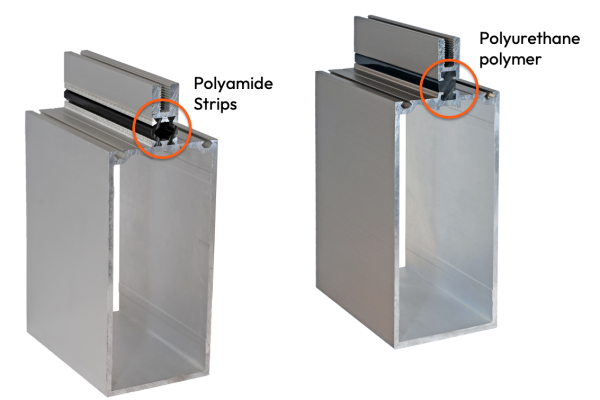

Thermal Break Manufacturing Explained: Polyurethane Pour & Debridge vs. Polyamide Struts
Aluminum framing remains the structural backbone of modern commercial fenestration, but without a thermal break it becomes a direct path for heat flow. The primary approaches used today, polyurethane pour-and-debridge (including solid and structural foam systems) and polyamide strut thermal barriers, achieve thermal separation in fundamentally different ways. For aluminum extruders, window fabricators, and product engineers, the choice influences production speed, cost structure, inventory management, and overall thermal performance.
In a polyurethane pour-and-debridge system, a two-part thermoset polyurethane is dispensed into a cavity between aluminum profiles, cured in place, and then mechanically debridged to eliminate metal-to-metal contact. Utilizing a mechanical lock, polyurethane forms a dense structural bond, while significantly lowering the U-factor in fenestration systems. Because polyurethane is dispensed in a liquid form, manufacturers store bulk material rather than multiple pre-formed parts. Modern multi-head dispensing systems support continuous, high-throughput operations even with extrusion with multiple thermal barrier cavities.
Polyamide strut thermal barriers, typically made from glass fiber–reinforced PA 6.6, use pre-extruded strips that are mechanically crimped into knurled aluminum profiles. Each cavity width requires a specific strut dimension, increasing SKU counts and inventory complexity. Tight profile tolerances are essential to ensure consistent mechanical interlock and long-term structural performance.
From a cost and logistics perspective, both systems require comparable investment in processing equipment. When it comes to thermal barrier materials, since polyurethane is dispensed as a liquid and cures to take the shape of the thermal barrier cavity in the aluminum extrusion, it does not require maintaining an inventory of unique polyamide struts for each fenestration product. In addition, the cost to create custom polyamide profiles is a significant capital expenditure that is passed on to the manufacturer.
Thermal conductivity also varies: polyurethane foam provides the lowest conductivity, followed by solid polyurethane, then glass-filled polyamide.
Ultimately, both polyurethane thermal barrier systems and polyamide strut systems are proven technologies in aluminum windows and curtain wall. The optimal solution often depends less on material preference and more on how the thermal break integrates into an organization’s extrusion process, fabrication workflow, performance targets, material costs and inventory complexity.